
Find Suffolk Residents by Record
No city-wide roster of Suffolk residents exists. Suffolk is an independent city, not a county, so its useful records live with separate custodians. For a current address, the assessor and GIS are the fastest first stop. A name tied to a public case points to the Virginia Courts route instead. A historic household calls for a dated directory, newspaper, deed, or map. That separation matters. An owner or mailing contact on an assessment record is no proof that anyone lives at the mapped property.
So pick the question first. An address identifies a parcel and its map setting. A full name plus a second detail, such as a date, street, role, or locality, works better against a court index or historical entry. Keep the source date beside every result. Suffolk records can also appear under Nansemond County, City of Nansemond, Holland, or Whaleyville. Earlier records often hide under those older names.
- Normalize the street address with the USPS lookup, then locate its mapped parcel through the assessor or GIS.
- Record the parcel account or tax-map number, borough, and source date before comparing another record.
- Use the Circuit Court Clerk or registered Virginia SRA route for deeds, plats, probate, or marriage-license questions.
- Check a public court path or an authorized voter route only for the narrow question that source can answer.
- For a dated household trail, ask the library or Library of Virginia for directory, newspaper, microfilm, and map holdings.
Suffolk Resident Record Custodians
Suffolk's current records sit with city departments, the Suffolk Circuit Court Clerk, and Virginia agencies. The Circuit Clerk holds land records, plats, probate, marriage licenses, and court files. The assessor keeps the assessment side of a parcel. The Registrar handles local election matters. None keeps a general resident roll. Each office sets its own access rules and correction route.
Suffolk Circuit Court Clerk
150 N Main Street
Suffolk, VA 23434
757-514-7800
Office of Real Estate Assessor
442 W Washington Street
Suffolk, VA 23434
757-514-7475
Suffolk General Registrar
440 Market Street, First Floor
Suffolk, VA 23434
757-514-7750
The Suffolk street directory details assessor and GIS records. Historical lookups use other custodians and record dates. The City of Suffolk Real Estate Assessor page names the office and its official property-search path.
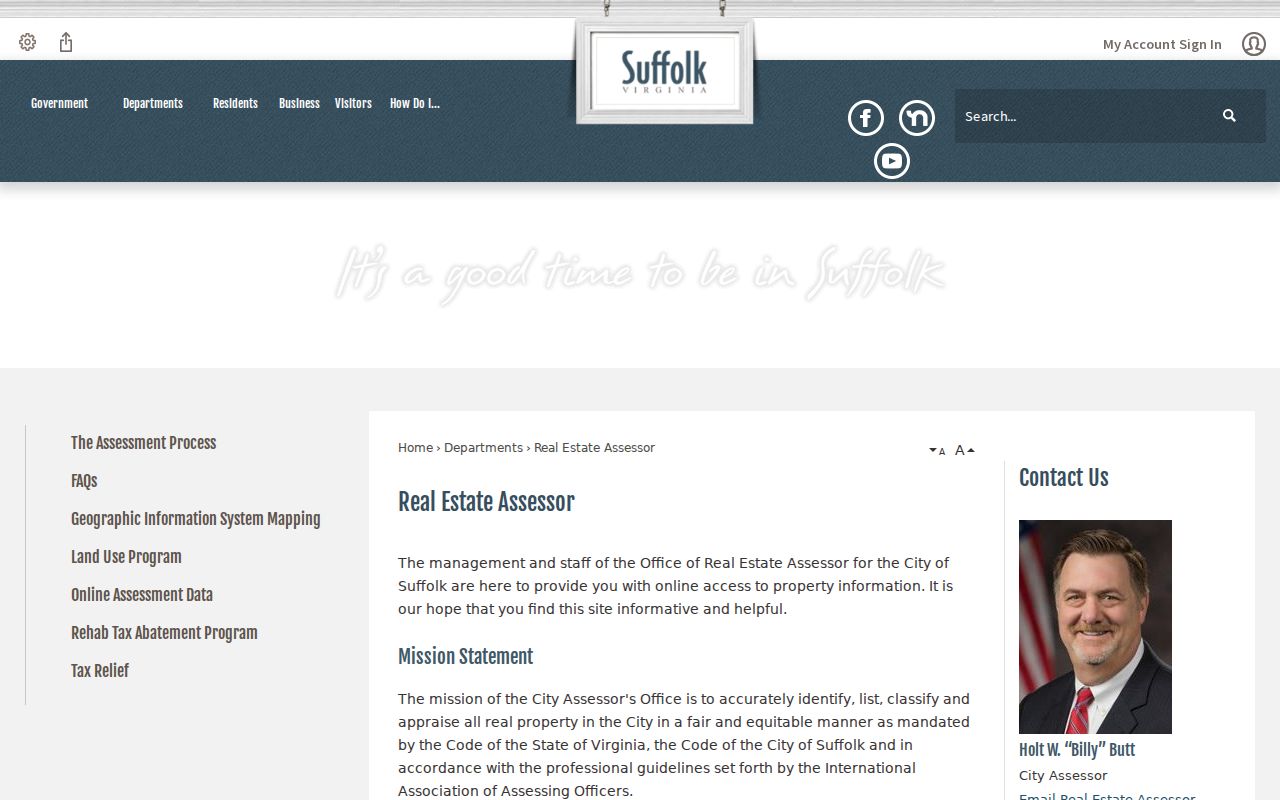
That route answers assessment questions only. The clerk and the registrar handle the rest.
Suffolk Parcel Records by Address
Suffolk assessment and GIS layers come first for an address. Their documented parcel-owner schema ties a mapped address to a tax-map number, account number, owner-of-record, mailing fields, borough, zoning, subdivision, neighborhood, property class, and building-use context. That helps when a deed or older record gives a lot description rather than a familiar street number. Old records often do exactly that. Labeling still matters. A situs address marks the property's location. A mailing address only shows where tax mail goes, not who occupies the parcel.
| Search detail | Suffolk record use |
|---|---|
| Address or map location | Locates the public assessment parcel and GIS context. |
| Owner-of-record | Names the party carried on the assessment record, not a current-occupancy finding. |
| Tax map or account | Connects a parcel to deed, plat, permit, and request follow-up. |
| Borough and neighborhood | Supplies geographic context for a Suffolk record search. |
Suffolk Spatialest is the public assessment-property route linked by the city.
The search anchors a property record nicely. Still, no parcel field becomes a household roster.
Suffolk Court and Clerk Paths
A public court index shows a name listed as a party. The entry may carry a docket number, court or locality, case type, filing or hearing dates, status, and disposition. Displays vary by court. Suffolk leans on the Virginia Courts case-information route plus the local General District Court path. Virginia offers no single statewide circuit-court search. For circuit files and certified copies, ask the Circuit Clerk. That fallback also covers archived material and questions the web display cannot answer.
Land research runs on a separate track. The Virginia Secure Remote Access system gives registered public users land-record indexes and images through the local clerk. A grantor transfers an interest; a grantee receives it. Those paired names build a title trail. A deed party is not automatically the current resident. The Virginia Courts case information page lists the public court-search choices.
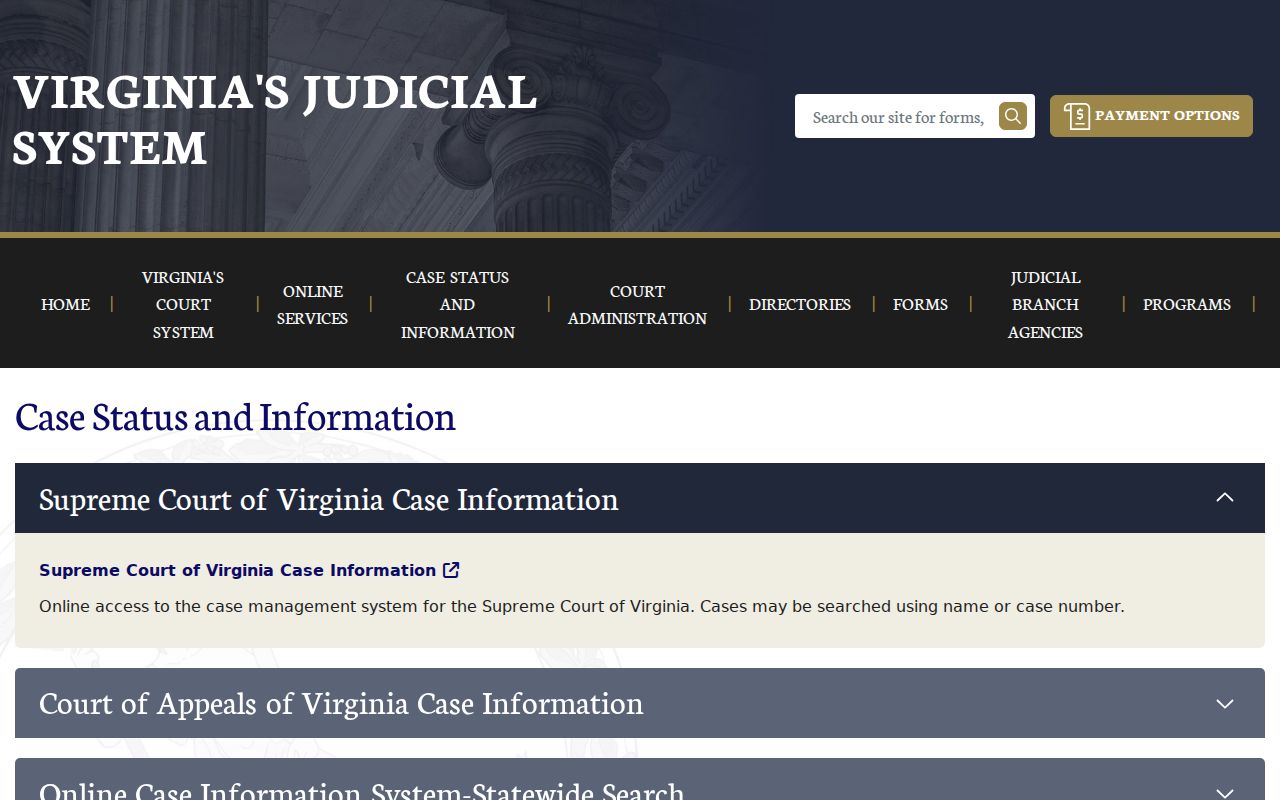
The clerk handles copies and fuller files. Use the clerk whenever an online result looks incomplete or confidential.
Suffolk Voter Records Have Limits
The Virginia Citizen Portal lets a voter check registration status, polling place, districts, and absentee actions. Public registration-list rules under Title 24.2 are narrower. They cover set fields: name, residence address, year of birth, gender, and election-district information. They exclude Social Security numbers, birth day and month, registration-agency identity, and protected details. Not everything in the system is public. A status lookup is not a street-wide export.
The broader voter-list request needs a qualified client type, a confirmed organizational email, chosen geography, election or date filters, and a selected product. Ask the Registrar when a record needs correcting. Suffolk approved a Huntersville/Lakeside polling-place change in January 2026. An old precinct document is not the final answer. A dated change can outrank it.
Current Suffolk Resident Record Sources
Not every current Suffolk source answers the same question. Assessment rolls name an owner-of-record. They also carry tax mailing fields. Voter rolls follow election law instead. A deed names only the people in a recorded transfer. Civic associations may publish a contact for their own group. Yet the city keeps no complete roster of associations or households. So treat each hit in a residents directory search as a record-specific lead. Confirm it with the keeper of that record before you rely on it.
| Record route | What it can confirm | Custodian | Access path |
|---|---|---|---|
| Assessment parcel | Owner-of-record, situs, mailing, account, and map context | City Assessor | Spatialest and GIS |
| Voter record | Statutorily public registration information and election geography | Registrar / Virginia Elections | Portal or qualified request |
| Land index | Grantor, grantee, instrument, recording details, and title clues | Circuit Court Clerk | Registered SRA or clerk request |
| Public case index | Public party and docket information | Virginia Courts / clerk | Case-information route and clerk |
| Civic organization entry | Organization contact information intentionally submitted or published | City form or association | Public contact route |
To check one full name across those separate Suffolk sources, the Suffolk resident lookup route keeps the comparison pinned to dates, locality, and record type.
Suffolk and Nansemond Record Gaps
Older Suffolk research runs into a different jurisdictional map. Nansemond County dates to 1646. The City of Nansemond existed only from 1972 until its 1974 consolidation into Suffolk, a merger that also absorbed the former city of Suffolk, Holland, and Whaleyville. When a street directory, deed, court order, or marriage record predates the modern city, search under those locality names too. A name absent from one label often appears under another.
Record loss is real here as well. Fires damaged or destroyed older material in 1734, 1779, 1837, and 1866, and the 1837 Suffolk fire took the courthouse and clerk offices with it. The Library of Virginia's Nansemond guide lists surviving or reproduced runs, among them general deed indexes from 1866 to 1904 and selected deed books from 1899 to 1913. Treat missing pre-1866 material as a preservation gap. It is not proof that a person or transfer never existed.
For registered users, Virginia Secure Remote Access is the clerk-linked land-record route.
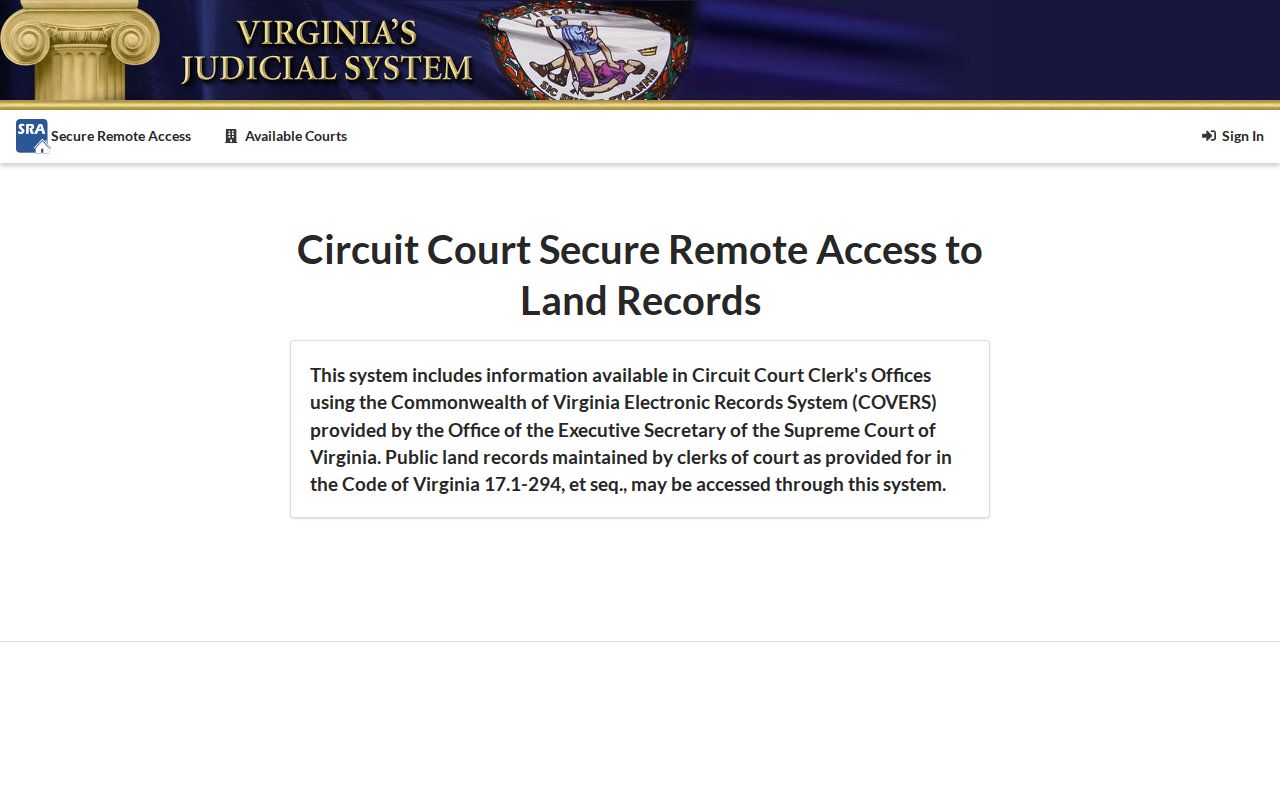
The online index is hardly the only channel. For an older record or one not displayed, the clerk, Library of Virginia microfilm, and a written copy request still matter.
Suffolk Vital Record Access
Suffolk birth, death, marriage, and divorce records come from the Virginia Department of Health. There is no separate city vital-record office. Virginia Code §32.1-271 opens birth records after 100 years. Death, marriage, and divorce records open after 25 years, subject to the statute and its exceptions. A current record requires the right relationship, legible identification, and a proper request. The certificate or search fee is $15, effective July 1, 2026.
VDH accepts online, mail, Richmond walk-in, express-service, and DMV customer-service-center requests. The online application page reports roughly 20 days of processing. The forms guidance puts paper processing at about four weeks. A public index, an uncertified image, and a certified copy are three different products. For a marriage, the state certificate path and the Circuit Clerk's underlying license file are separate routes as well.
Virginia Vital Records explains the custodian, the access periods, and every request channel.
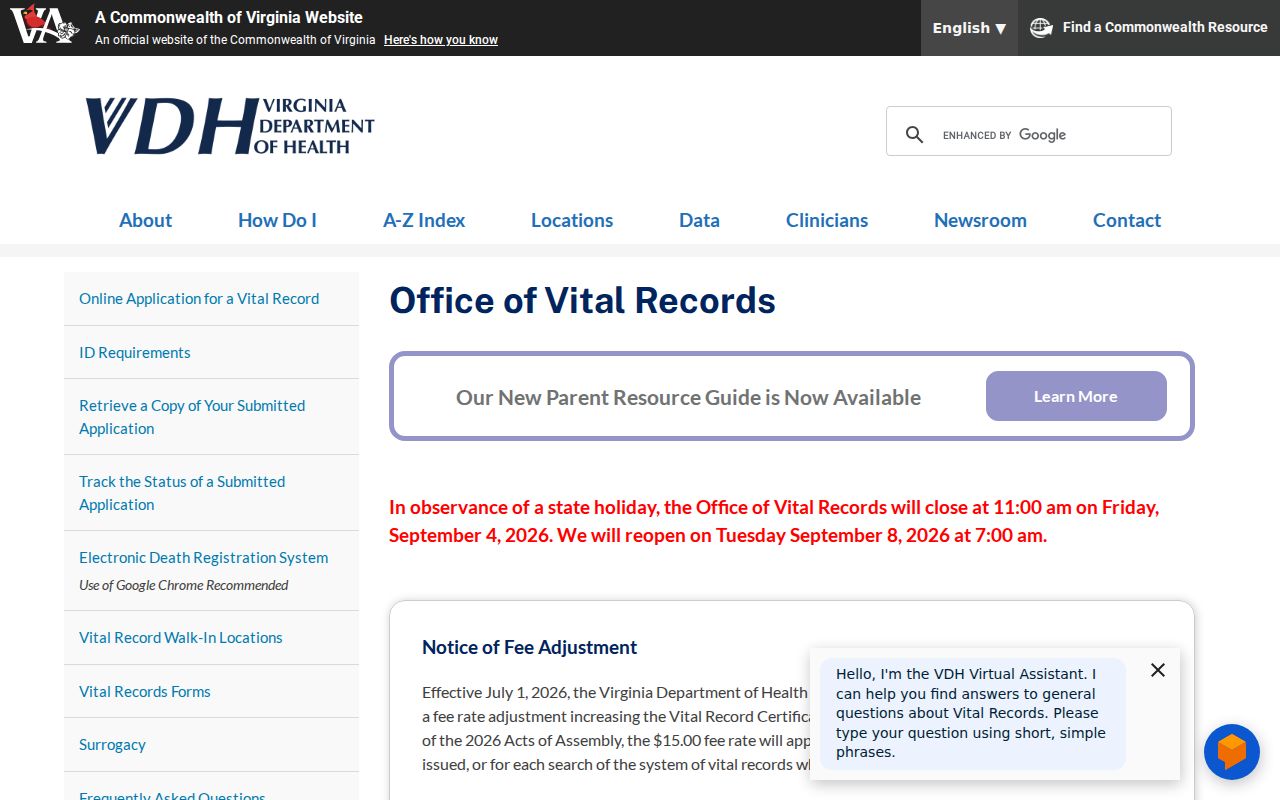
Know the event type and the record year before you begin. That detail decides which VDH procedure a Suffolk request must follow. The fastest route is VDH's online vital-record application, which handles the request electronically.
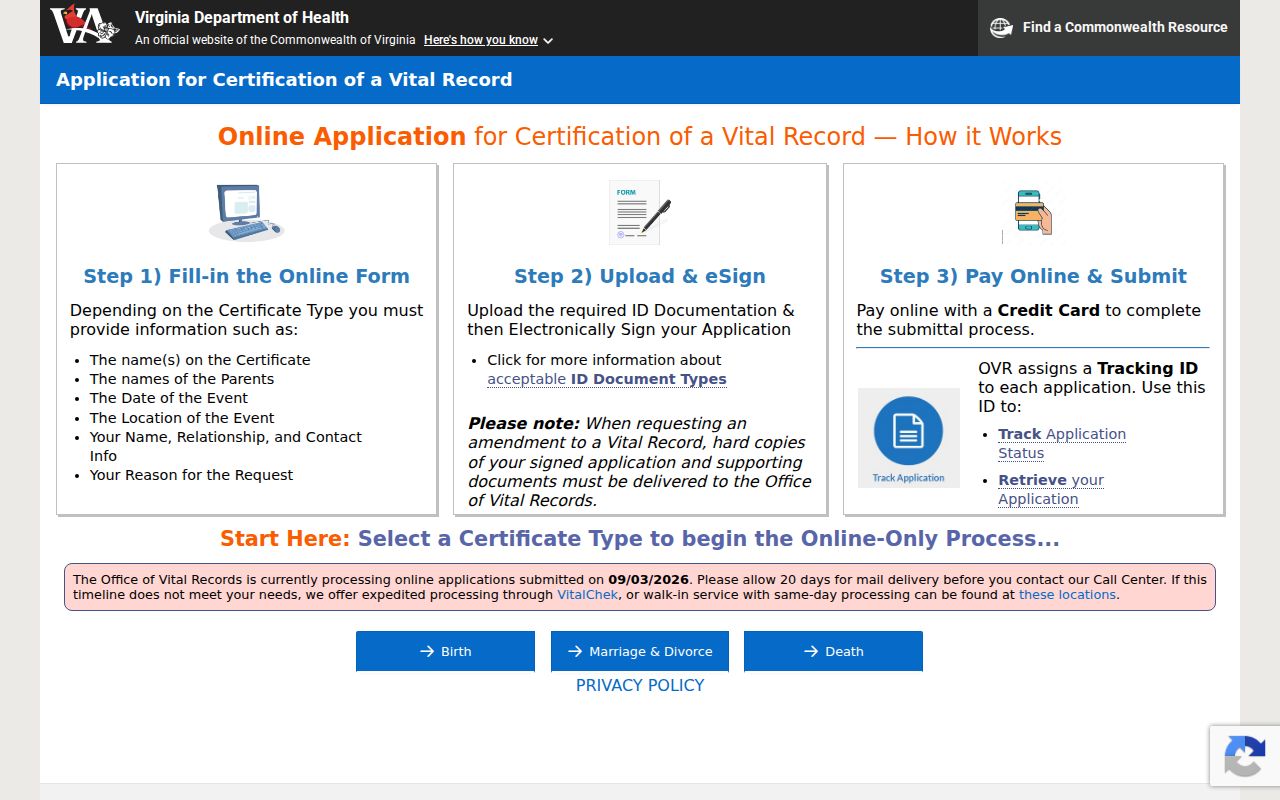
The application gathers event and requester details, and legal eligibility still governs the whole request.
Suffolk FOIA for City Records
A Virginia Freedom of Information Act request is the fallback. The city holds a municipal record but publishes no portal version of it. Describe the records with reasonable specificity. Virginia FOIA generally calls for a response within five working days. Statutory options apply when a full response is impractical. The city need not build a new analysis or answer an open-ended question. Court records belong with the clerk and court procedures, not FOIA.
Suffolk accepts requests through its JustFOIA portal, email, mail, fax, phone, or in person. The city may charge actual search, redaction, duplication, and database-format costs. It may also require a deposit where the statute allows one. Name the exact record, timeframe, department, and preferred format. That lets records staff find an existing document without guessing what you mean.
Virginia FOIA §2.2-3704 sets out the request mechanics.
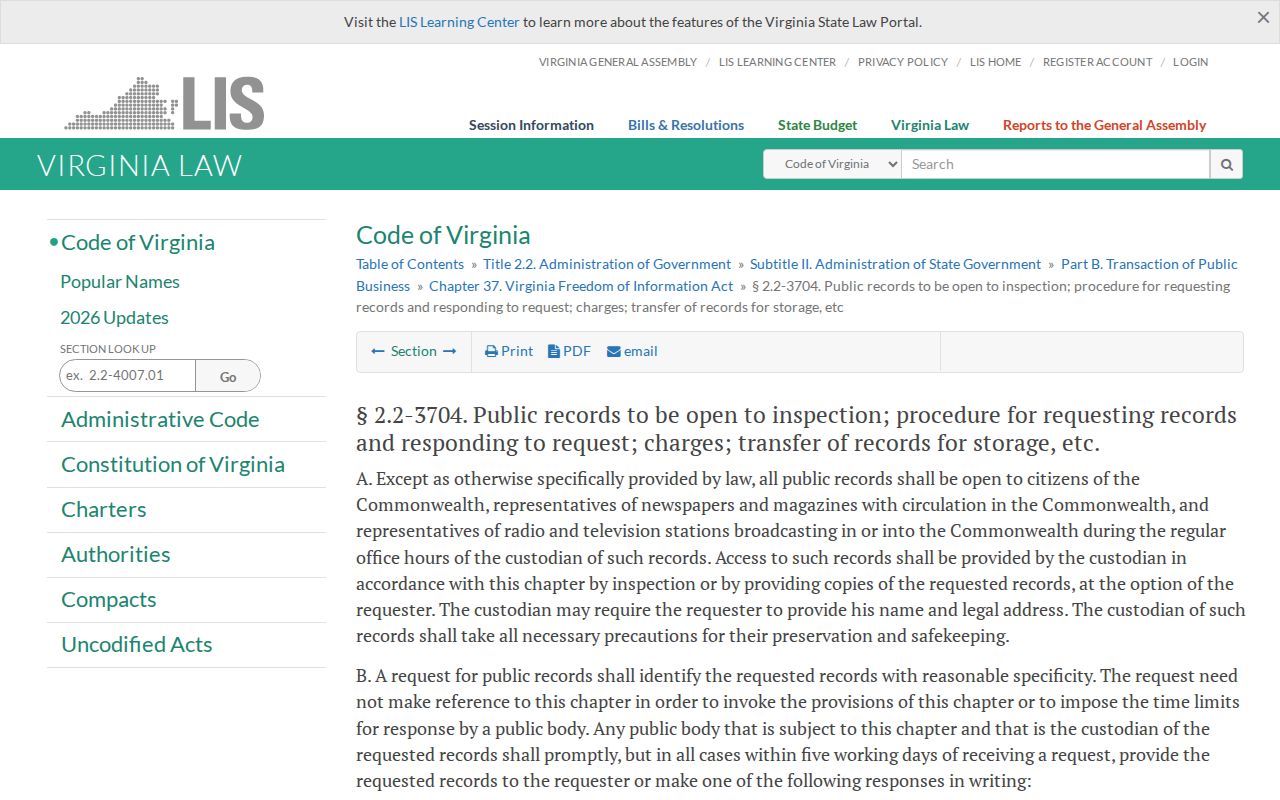
The statute frames a request for existing records, not a demand for a new resident list or a court-file substitute.
Suffolk JustFOIA is the online municipal-record intake portal.
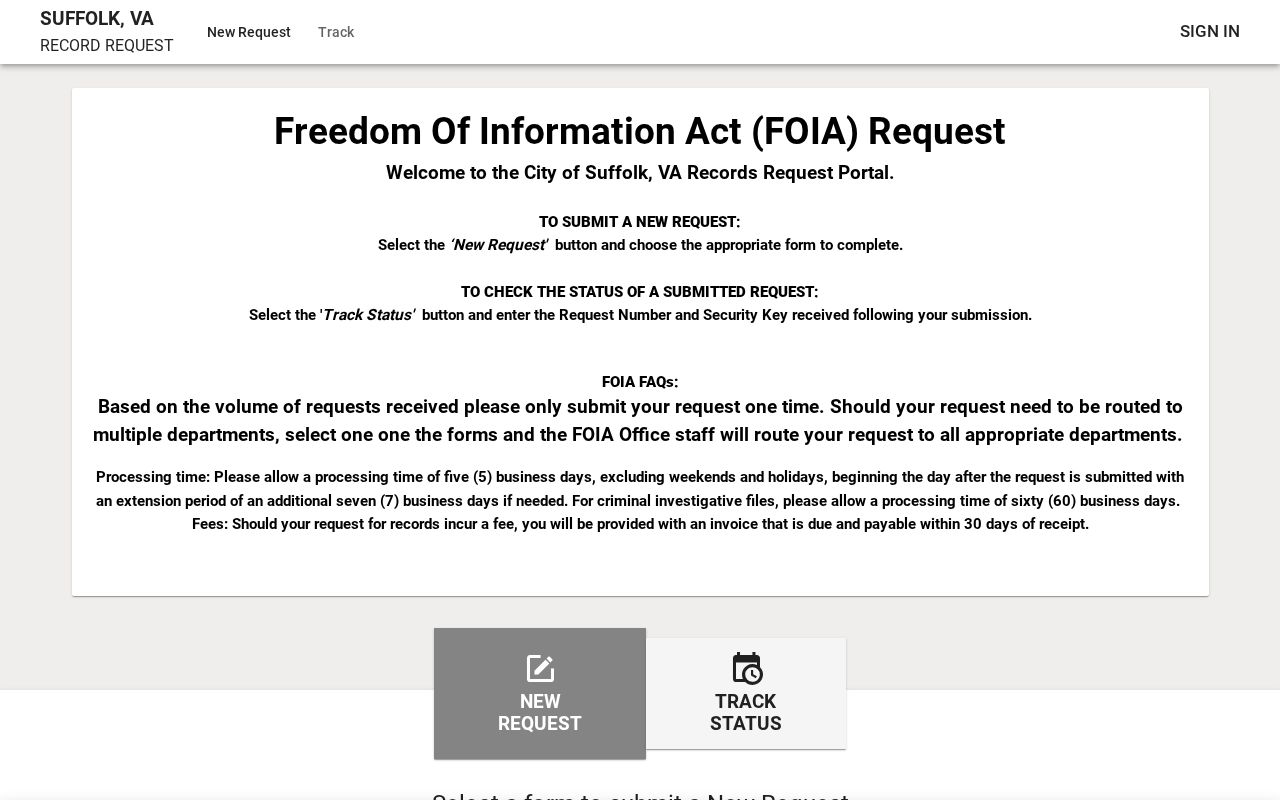
Give the portal a narrowly stated request and keep the confirmation for follow-up.
Suffolk's FOIA Office publishes the local procedure and contact route.
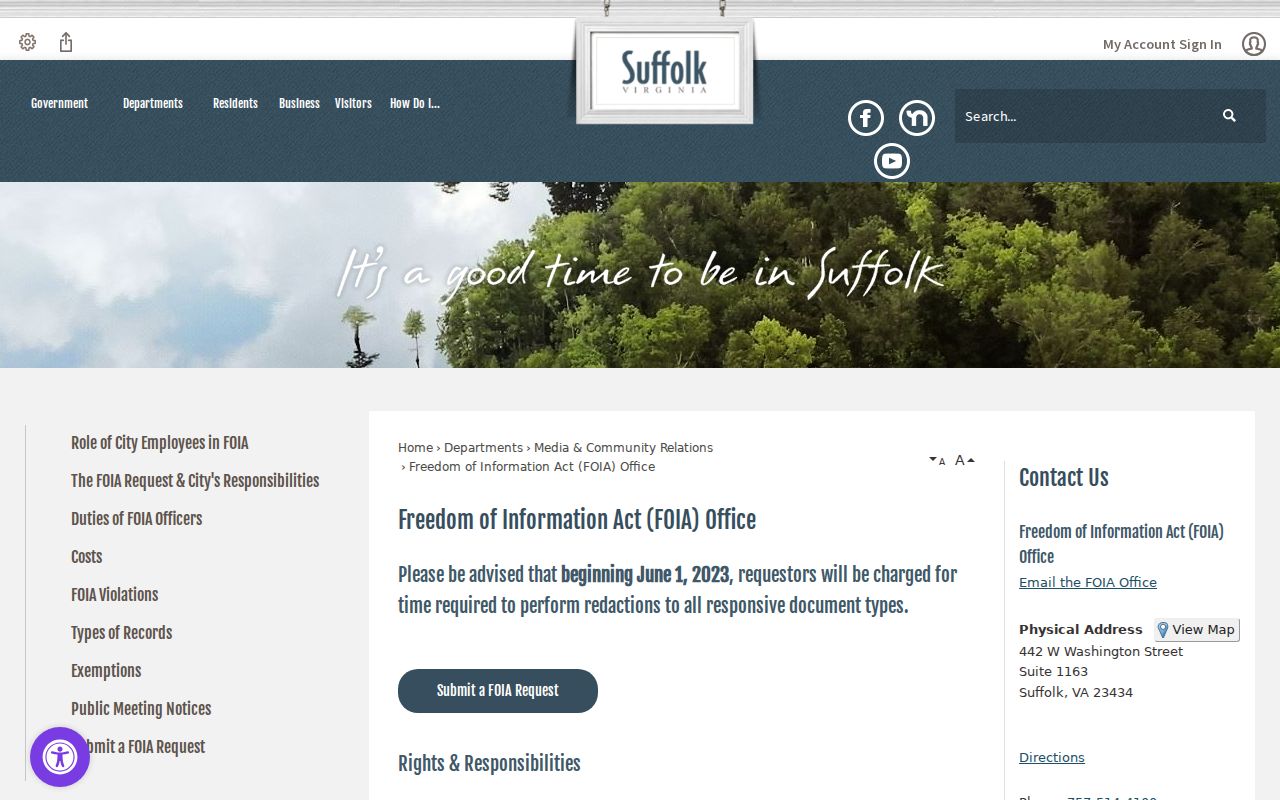
The office can explain the city's process. For what a record means, or to fix an error in it, the responsible custodian remains the best source.
Suffolk Boroughs Shape Searches
Geography adds useful context to any Suffolk record trail. The GIS identifies seven boroughs: Chuckatuck, Cypress, Holy Neck, Nansemond, Sleepy Hole, Suffolk, and Whaleyville. Its layers go further. They distinguish address points, parcels, streets, precincts, schools, flood and surge information, historic areas, land use, and transportation. A borough or precinct can narrow a map question. But neither label proves someone belongs to a household, group, or neighborhood association.
- Parcel
- A mapped property unit tied to an account or tax-map reference.
- Index
- A finding tool that points to a record; it is not always the record image or a certified copy.
- Criss-cross directory
- An address-arranged directory that can show a dated printed association with an address.
- Record roll
- A source-specific list, such as an assessment or registration record, with its own date and legal limits.
Use the city map layer to keep those geographic labels distinct rather than blending them into one claim about a Suffolk resident.
Historical Suffolk Resident Directories
Printed directories are household and business evidence from a specific year. They are not proof of where someone lives now. The Library of Virginia holds a range of Virginia city directories spanning 1873 through 1960. Two Suffolk titles appear in the official historic-district nomination. These are City of Suffolk, Virginia from 1930 and Hill's Suffolk City Directory from 1957. The library publishes no full issue list for these runs. Confirm a particular year there before a search depends on it. Ask about reverse-directory coverage too. Shelf years for criss-cross volumes are not listed in the official sources.
A full city-directory trail can run from a name index to the printed entry. It can then lead to an address or criss-cross listing, a later directory year, a released census year, newspaper evidence, and a deed or probate record. The Suffolk directory book walks through those collections and their abbreviations. Note: record the page number, year, repository, and whether an image was inspected.
Suffolk Library Research Help
Suffolk Public Library is the local handoff for genealogy and house-history questions. Its Genealogy & History resources cover local obituaries, newspapers, city directories, Ancestry records, Library of Virginia material, National Archives holdings, school yearbooks, and the Suffolk Nansemond Historical Society. Ancestry Library Edition requires in-library access at a Suffolk location plus a free account. Virginia Chronicle is free. HeritageHub access may depend on library credentials.
Staff describe up to four hours of limited assistance for a narrow request. Eligible topics include local obituaries, local articles, city directories, Ancestry vital or census records, and Hampton Roads connections. A discovery appointment is generally capped at one hour. The best request names the person, approximate dates, street, borough if known, and the exact record question. Broad all-family research falls outside the service. That focused handoff makes a historical Suffolk lead far easier to verify.
Note: Ancestry Library Edition works only inside a Suffolk library location.
Protected Suffolk Address Limits
Public access does not erase privacy or safety rules. Virginia's Address Confidentiality Program helps an eligible survivor of domestic violence, stalking, sexual violence, child abduction, or human trafficking. It provides a substitute mailing address with mail forwarding. The physical address stays with program staff and law enforcement for law-enforcement purposes only. Virginia agencies and local agencies must accept the substitute address. Private and federal entities are not universally required to do so. The program is not retroactive. It cannot guarantee that every past disclosure disappears.
Virginia's Consumer Data Protection Act gives qualifying consumers defined rights over covered personal data. It does not create a universal way to remove official public records. If a record seems wrong, contact the agency that issued it. The owner field, voter record, and court entry each have their own correction path. The historical directory also has its own access path.