
Suffolk City Directory Holdings
Historical directory research in Suffolk starts with the Library of Virginia and Suffolk Public Library local-history access. The Library of Virginia describes a selection of Virginia city directories from 1873 through 1960. For Suffolk itself, the official Historic District nomination verifies two examples: City of Suffolk, Virginia for 1930 and Hill’s Suffolk City Directory, issued in 1957 by Hill Directory Company of Richmond. Those are verified examples, not proof of an uninterrupted local run.
| Collection | Years confirmed or described | Where held | Access route |
|---|---|---|---|
| Virginia city-directory selection | 1873–1960 selection | Library of Virginia | Browse locality and year where access rights permit |
| City of Suffolk, Virginia | 1930 verified example | Library of Congress citation; library or Ancestry image to verify | Confirm image, page, and publisher before citing an entry |
| Hill’s Suffolk City Directory | 1957 verified example, Hill Directory Company | LVA, library, or Ancestry image to verify | Check the actual volume and its abbreviation key |
| Reverse or criss-cross volumes | Local shelf years not located in official sources | Suffolk Public Library local-history reference | Ask staff to confirm holdings before requesting an address search |
Local telephone books, obituary files, church registers, and reverse volumes may be useful companions, but their exact Suffolk coverage was not confirmed online. Ask the library about a particular year rather than assuming every volume or address section survives.
The Library of Virginia’s Ancestry for Virginians collection page shows the state access route for digitized city-directory material.
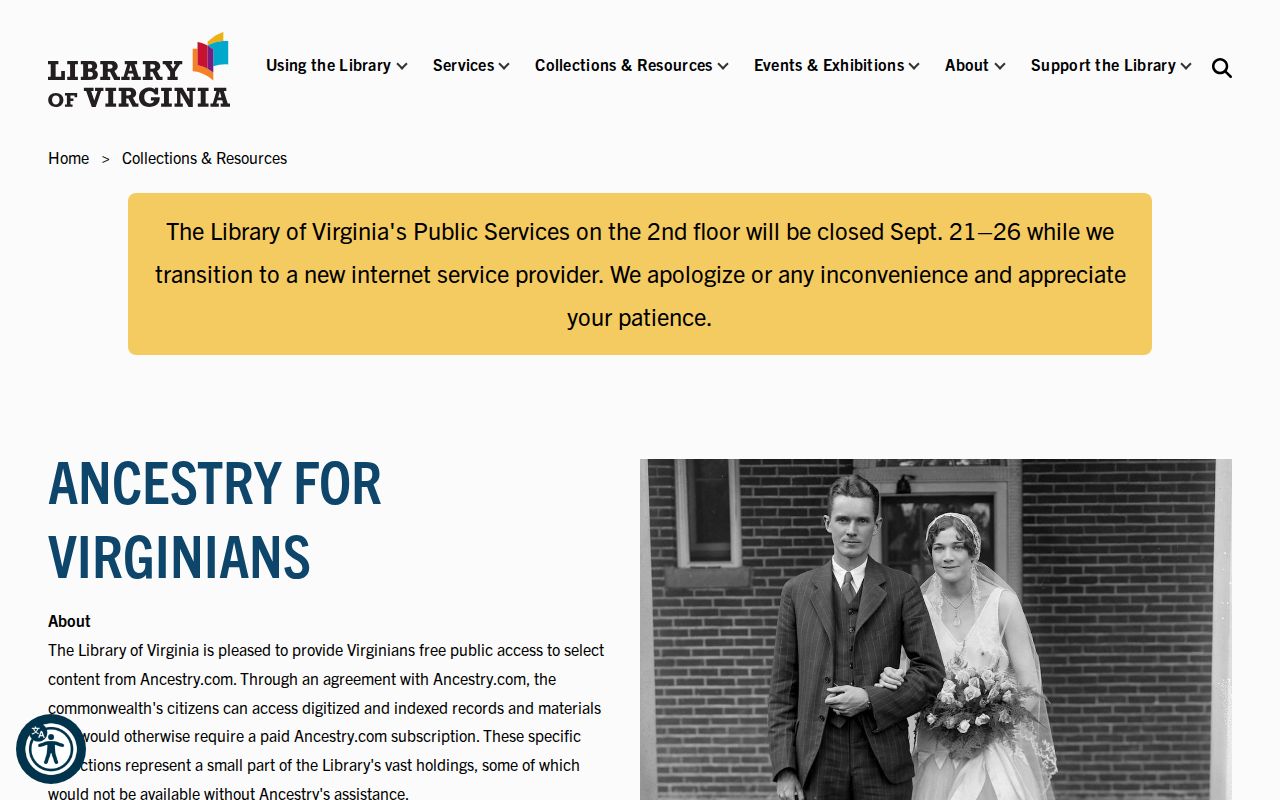
Use the collection image as a starting point, then inspect the directory page itself before transcribing an address or household notation.
Suffolk City Directory Years
A broad Virginia date range should not be mistaken for a Suffolk-by-Suffolk checklist. The LVA selection spans 1873–1960, while the research confirms the 1930 and 1957 local examples named above. Individual issue, publisher, and image availability can change by year. A search result can be an index lead rather than an accessible page, so capture the locality, volume year, page, and repository along with the entry.
The Library of Virginia site index offers another way to navigate archival collections and services when a locality search is incomplete.
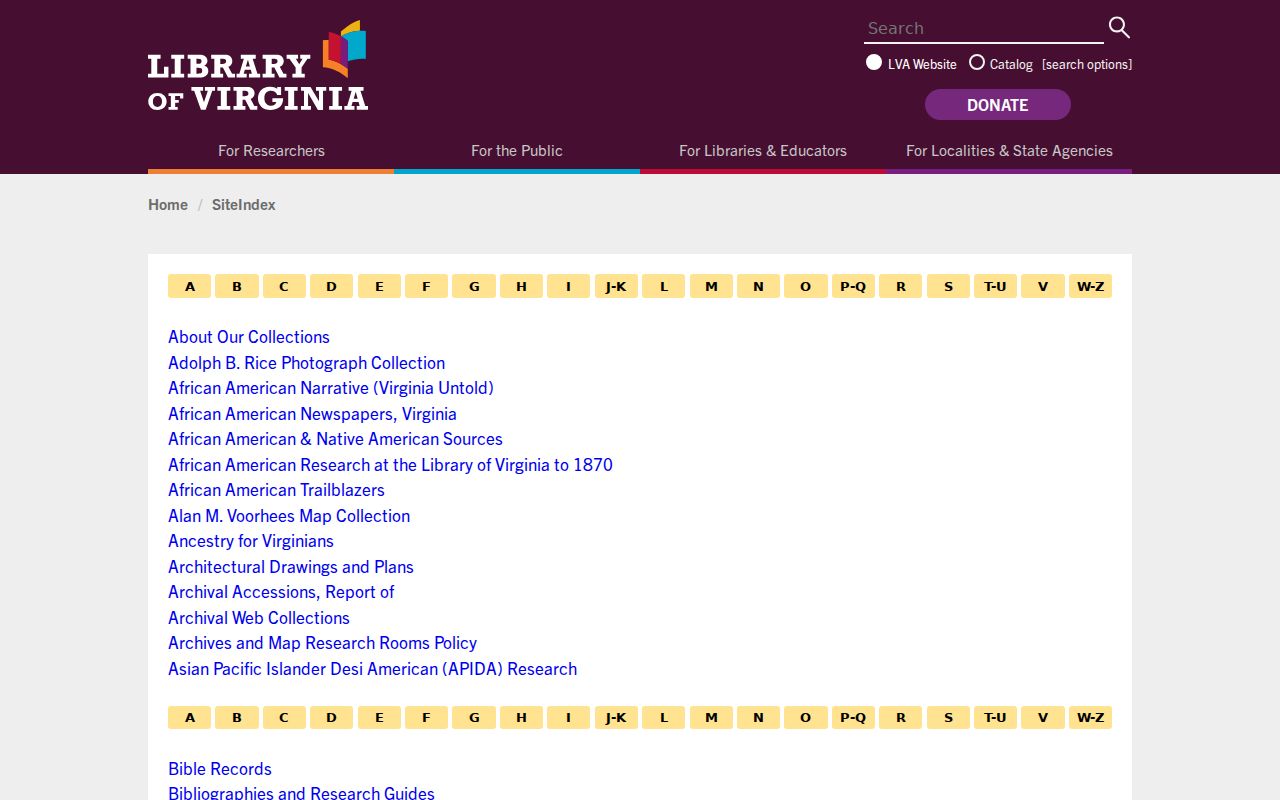
That navigation route is particularly useful when a title is known but the accessible image, catalog record, or reading-room path needs confirmation.
Note: A year listed by a statewide collection describes available selection scope, not a promise that every Suffolk issue or directory section can be viewed online.
Suffolk City Directory Access Paths
Suffolk Public Library Genealogy & History is the main local research hub. Staff can point a focused request toward local obituaries, newspapers, directories, Ancestry material, the Library of Virginia, National Archives resources, and the Suffolk Nansemond Historical Society. Ancestry Library Edition requires being inside a Suffolk Public Library location and a free Ancestry account. That distinction matters when an online account sees a result but cannot open an image.
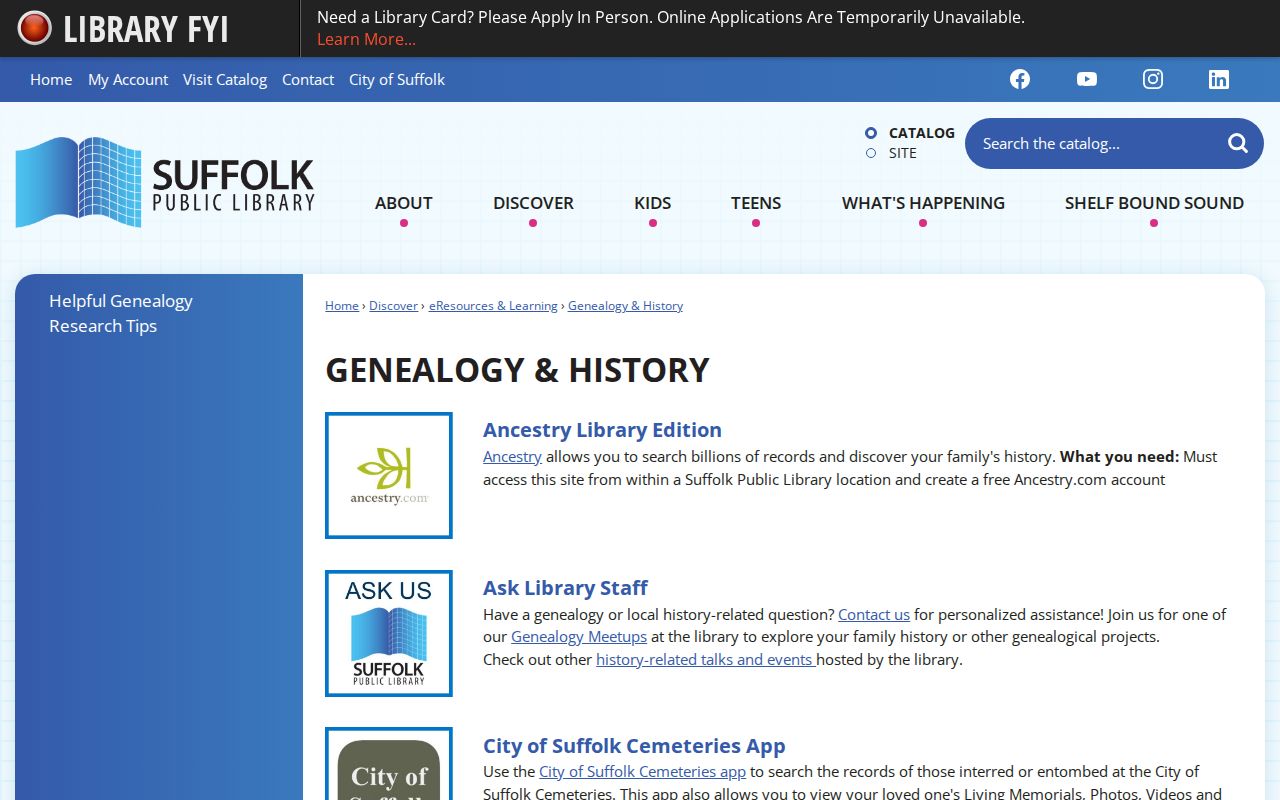
The library page identifies the local path for staff referral and database use, rather than claiming that all historic volumes are freely available from home.
The Library of Virginia gives free in-state Ancestry access after GeoIP validation and a free account, with full access in its reading rooms. The FamilySearch city and business directory collection covers approximately 1749–1990. It may index a name, occupation, address, and other directory fields. Account access and image rights can vary, so a matching index entry remains a dated lead until the source image and repository are checked.
Use the collection’s person and place controls to narrow a search, then retain the image citation instead of relying only on the indexed wording.
Suffolk City Directory Local Repositories
The Suffolk Nansemond Historical Society collections page is a first-party local institutional lead. The page’s collection details did not render in the research capture, so it does not support naming specific directory titles, current hours, finding aids, or reproduction rules. Contact the society to confirm whether a particular year, map, yearbook, or local-history collection is available.
The institutional collection route can complement library work, especially where a dated directory entry needs neighborhood, yearbook, or preservation context.
Virginia Chronicle and the library’s newspaper resources are useful follow-ups for an address or name found in a volume. OCR can be imperfect. Save the newspaper title, issue date, page, and stable item link with the original directory reference.
Suffolk City Directory Locality Names
Search terms need to follow the jurisdiction printed at the time. Suffolk is an independent city today, but earlier sources can use Nansemond County, City of Nansemond, Suffolk, Holland, or Whaleyville. The 1974 consolidation joined Suffolk, Nansemond County, Holland, and Whaleyville. A negative search under one modern name is not enough when a directory, deed, newspaper, or map may use an earlier locality.
Records also carry physical gaps. Suffolk’s 1837 fire destroyed the courthouse, clerk offices, jail, and more than 130 buildings. Major fires followed in 1885 and 1888. These events changed the built landscape and reduced survival of some records. A current street name may outlast an older block description, while a historical address can need a map or deed before it connects to a current parcel.
The old town grid placed Main and Back Streets parallel to the river with North and South Cross Streets at right angles. This small geography detail can help locate a printed address near the older commercial core.
Read a Suffolk City Directory Entry
Read an entry as a set of printed facts from a stated year. A full image can include a surname and given name, spouse in parentheses, occupation or business notation, a street address, an ownership notation, widow notation, a business address, a later-volume telephone entry, and abbreviated terms. The research did not inspect an individual Suffolk image in text mode, so the exact key and printed symbols must be verified in the volume before they are expanded.
| Name and spouse notation | Identifies how the publisher printed the person and any parenthetical spouse information. |
|---|---|
| Occupation or business notation | Supplies a dated activity or address clue, not a present-day status. |
| Street or business address | Connects the entry to a particular year and printed locality. |
| Ownership or widow notation | Must be read through the volume’s own abbreviation key rather than guessed from another year. |
| Page and volume | Preserves the citation needed to return to the original image. |
- Criss-cross directory
- An address-ordered section that can lead from a street number to a printed occupant entry. Suffolk run years need confirmation from library staff.
- Householder index
- A name-oriented listing that may organize household heads or principal entries rather than every person at an address.
- Abbreviation key
- The publisher’s explanation of the short marks used in that volume. Photograph or transcribe it with the entry.
Suffolk City Directory Gaps
Directories omit as well as include. A person may have moved, died, been unlisted, appeared under a variant name, or simply fall in a year not held by the repository. Reverse-directory shelf dates, local obituary-index years, church-register coverage, funeral-home files, and many telephone-book runs were not located in official online sources. Ask for a targeted shelf check before treating absence as a historical conclusion.
The Library of Virginia’s Nansemond guide is an important alternate route for land, court, plat, and marriage material. It identifies general deed indexes from 1866–1904, selected deed books from 1899–1913, county court order books from 1866–1904, and marriage-register or index material from 1866–1910. Those records provide dated corroboration, not an unbroken personal directory.
Trace Families Through Suffolk City Directories
Following a household works best as a dated chain. Start from the first volume that can be opened, record precisely what it printed, and move to the next available issue instead of filling a gap with assumption. Federal census schedules become publicly available under the 72-year rule, so they can help bridge the decade pattern when a directory sequence has missing years. Newspapers, deeds, probate, cemetery entries, and maps can test a move or a disappearance.
- Find the name in an accessible year and capture the image, volume title, page, locality, and the publisher’s spelling.
- Read the full entry and abbreviation key, then record the printed street or business address without silently modernizing it.
- Check the next available volume for a move, changed notation, or a different spelling, and note every skipped year.
- Ask whether a reverse or criss-cross volume exists for the address, then pair the dated result with the relevant released census year.
- Corroborate a meaningful change with Virginia Chronicle, a deed or probate source, a Sanborn sheet, or a repository-held obituary record.
Library staff offer limited research assistance of up to four hours for focused questions involving local obituaries, articles, directories, Ancestry vital or census records, and Hampton Roads connections. Requests should give names, dates, places, and a specific question. Broad all-family work is outside that service, and discovery appointments are generally limited to one hour.
For a present-day address-to-parcel question after the historical work is complete, use the Suffolk street records route rather than applying an old entry to a modern property without another source.
Suffolk City Directory Timeline
The timeline below explains why a directory search may need more than one locality name or repository. It combines the verified local examples with city history and does not invent a complete publication history.
- 1837: The Great Fire destroys the courthouse, clerk offices, jail, and more than 130 buildings, creating a major preservation caution.
- 1885 and 1888: Major business-district fires alter the built environment and add another reason to check maps and contemporaneous sources.
- 1930: City of Suffolk, Virginia is a verified local directory example in the Historic District nomination.
- 1957: Hill’s Suffolk City Directory, issued by Hill Directory Company of Richmond, is another verified local example.
- 1974: Consolidation creates the modern Suffolk jurisdiction from Suffolk, Nansemond County, Holland, and Whaleyville.
Note: The timeline identifies research anchors, not every local issue, publisher change, or survival date in the historical shelf.
Suffolk City Directory Proof Rules
A printed entry is strong evidence of what the directory showed in that year. It is not proof of a current address, an entire household, or a relationship not stated in the source. Preserve the exact page, date, publisher, repository, locality name, and abbreviation key. If OCR supplied the lead, compare it against the image because initials, street names, and numbers can be read incorrectly.
Research boundary. Keep a historical directory finding tied to its source year, and seek an official custodian or an additional dated record before relying on it for a consequential question.
The city’s library, LVA, historical society, clerk, and archival newspaper sources provide the practical fallback chain when an online index does not expose the needed image or year.